
PMET Produces High Recovery (89%) and High Grade Spodumene Concentrate (6.1% Li2O) from Innovative CV5 Sample and DMS Pilot Program

MONTREAL, May 3, 2026 /PRNewswire/ – May 4, 2026 – Sydney, Australia
Highlights
- The program (termed “ApplePick”) utilized multiple large, angular, mineralized boulders situated immediately down-ice of the principal CV5 outcrop (i.e., the source), which were crushed on-site and shipped to SGS (Lakefield) as high head-grade (3.61% Li2O)1 feed for processing in a DMS pilot plant.
- 4.47 tonnes of high-grade (6.09% Li2O) and low-iron (0.58% Fe2O3) spodumene concentrate was produced at very high recovery (89.0%) from the CV5 Pegmatite using a Dense Media Separation (“DMS”) only pilot plant.
- The concentrate produced further demonstrates the potential for the Company’s proposed DMS only processing pathway for Shaakichiuwaanaan, through;
- High-grade and consistently large spodumene crystal nature, which contributes to high rates of recovery using just DMS processing; and
- Reinforces prior test work demonstrating a clean ≥SC5.5 concentrate at high rates of recovery (nominally 70%), per Feasibility development plans and planned average mined heads grades over the life-of-mine.
- Approach allowed for the rapid and cost-effective generation of spodumene concentrate on a larger scale, without drilling, which further supports the Company’s future lithium offtake and midstream product initiatives.
- DMS tailings streams from the pilot also generated significant quantities of feed material for the Feasibility-level tantalum recovery program, which is now underway.
- New higher-grade lithia feed samples have generated the data that underpins an improved lithium grade-recovery curve and indicates that stronger recoveries can be achieved at the high-grade end of the curve compared to previous assumptions, which is expected to positively impact the results of the upcoming updated Feasibility Study for the CV5 Pegmatite, as well as a Preliminary Economic Assessment for the broader Project.
- Given the success of the ApplePick program, the Company intends to launch the ‘BerryPick’ program, targeting surface pollucite samples for larger scale pilot testwork and concentrate sample preparation, as it engages with strategic caesium players downstream.
|
__________________________________ |
|
1 This head-grade of feed relates to the grade of composited boulders from CV5 selected as part of Project ApplePick and is not representative of expected life-of-mine feed grade as reported in the CV5 Feasibility Study released on October 20, 2025. |
Darren L. Smith, Executive Vice President Exploration, comments: “The ApplePick program further demonstrates the potential of our DMS only processing pathway and exceeded our expectations in terms of concentrate grade, quality, and tonnes produced. It is an excellent example of the team’s innovative thinking, resulting in a practical and cost-effective approach to generate sample product at scale, without significant core drilling being required.
“In addition to allowing us to be able to provide substantial quantities of spodumene concentrate from our Shaakichiuwaanaan Project to support our offtake and midstream initiatives, ApplePick has also provided us with significant quantities of tailings material feed to support our Feasibility-level tantalum recovery testwork programs,” added Mr. Smith.
PMET Resources Inc. (the “Company” or “PMET”) (TSX: PMET) (ASX: PMT) (OTCQX: PMETF) (FSE: R9GA) is pleased to announce the successful production of approximately 4.47 tonnes of high-grade (6.09% Li2O, low iron) spodumene concentrate from the CV5 Pegmatite at the Company’s wholly-owned Shaakichiuwaanaan Property (the “Property” or “Project”), located in the Eeyou Istchee James Bay region of Quebec.
The pilot-scale program delivered a premium 6.09% Li2O spodumene concentrate at low iron levels and very high recovery (89.0%), providing a high-quality product to advance offtake discussions and downstream processing initiatives. This testwork has also provided a critical data point for assessing lithium recovery from high-grade feed, in the 3% Li2O range.
The Shaakichiuwaanaan Property hosts one of the largest pegmatite Mineral Resources2 (Li, Cs, Ta) and Mineral Reserves3 (Li) in the world, situated approximately 13 km south of the regional and all-weather Trans-Taiga Road (accessible year-round by road) and Hydro Quebec infrastructure corridor. The Company recently announced a robust lithium-only Feasibility Study for the CV5 Pegmatite, which positions the Project as a potential North American critical mineral powerhouse (see news release dated October 20, 2025).
|
___________________________________ |
|
2 The Consolidated MRE (CV5 + CV13 pegmatites), which includes the Rigel and Vega caesium zones, totals 108.0 Mt at 1.40% Li2O, 0.11% Cs2O, 166 ppm Ta2O5, and 66 ppm Ga, Indicated, and 33.4 Mt at 1.33% Li2O, 0.21% Cs2O, 155 ppm Ta2O5, and 65 ppm Ga, Inferred, and is reported at a cut-off grade of 0.40% Li2O (open-pit), 0.60% Li2O (underground CV5), and 0.70% Li2O (underground CV13). A grade constraint of 0.50% Cs2O was used to model the Rigel and Vega caesium zones. The Effective Date is June 20, 2025 (through drill hole CV24-787). Mineral Resources are not Mineral Reserves as they do not have demonstrated economic viability. Mineral Resources are inclusive of Mineral Reserves. |
|
3 Probable Mineral Reserve of 84.3 Mt at 1.26% Li2O at the CV5 Pegmatite with a cut-off grade is 0.40% Li2O (open-pit) and 0.70% Li2O (underground). Underground development and open-pit marginal tonnage containing material above 0.37% Li2O are also included in the statement. The Effective Date is September 11, 2025. See Feasibility Study news release dated October 20, 2025. |
Spodumene Concentrate Production (Project ApplePick)
In the second half of 2025, the Company devised a novel approach to cost-effectively produce further quantities of spodumene concentrate from Shaakichiuwaanaan using a pilot scale DMS processing facility, to satisfy third-party sample requests and support its own midstream lithium processing development initiatives. The program, termed “ApplePick“, utilized the collection of well mineralized spodumene pegmatite boulders situated immediately down-ice of the principal CV5 outcrop that were readily accessible via all-season road and access trails. Based on the boulders’ location, size, and angularity, the source was concluded to be from the immediately adjacent CV5 Pegmatite Deposit, and most likely the principal outcrop.
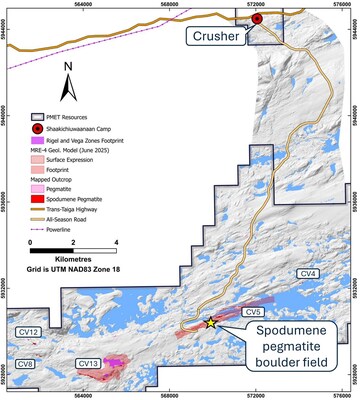
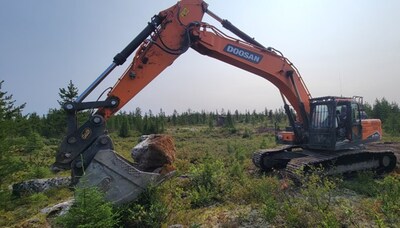
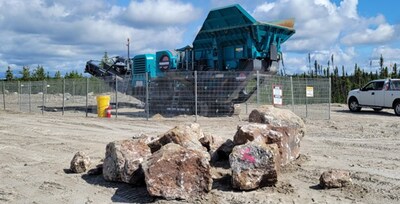
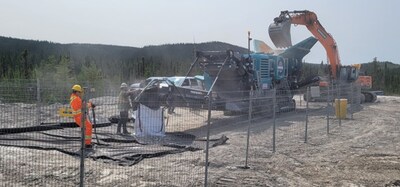
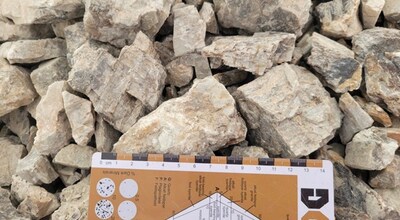
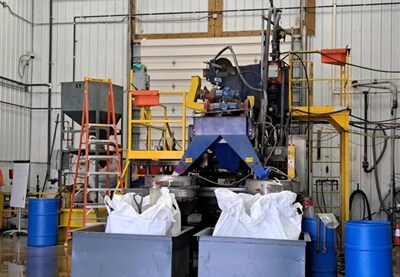
Approximately 9.5 tonnes of mineralized boulders were collected at the site via backhoe and transported, via all-season road, to the Company’s mobile crusher located adjacent to camp (Figure 1, Figure 2, and Figure 3). The boulders were crushed to roughly fist size (~10 cm) and placed directly into bulk bags via the crusher’s conveyor (Figure 4 and Figure 5). The bulk bags were shipped to SGS Canada’s Lakefield – Ontario, facility where the samples were further sized and processed through a Dense Media Separation (“DMS”) pilot plant (Figure 6 and Figure 7).
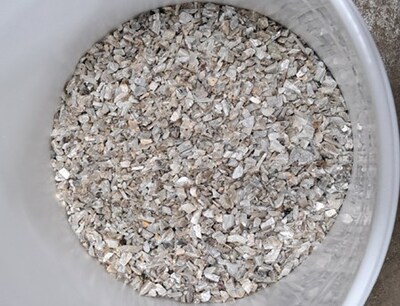
The DMS pilot produced approximately 4.47 tonnes of high-grade 6.09% Li2O spodumene concentrate at a low iron content (0.58% Fe2O3) and a high recovery of 89.0%. A portion of the concentrate was then run through a standard magnetic separation circuit which resulted in the production of 1.65 tonnes of 6.32% Li2O (0.45% Fe2O3) concentrate in the non-magnetic fraction, leaving 2.70 tonnes of 6.09% Li2O (0.58% Fe2O3) concentrate without magnetic separation.
Shaakichiuwaanaan Project Benefits
The program produced significantly more concentrate than expected, in part due to the high head-grade (3.61% Li2O) of the composited boulders, but also due to the achievement of a higher-than-expected lithia recovery (89.0%). Importantly, this has further derisked the Company’s proposed DMS-only flowsheet and provides a key additional data point on the lithium recovery curve for the Project where, normally, feed grades in the 3% range are either not tested or otherwise typically not available at most projects.
Considering the tenor of the high-grade Nova (CV5) and Vega (CV13) zones at Shaakichiuwaanaan, this data point represents a valuable addition to the grade-recovery curve and indicates that stronger recoveries can be achieved at the high-grade end of the curve compared to previous assumptions. At a feed grade of 2% Li2O, the results of Project ApplePick indicate an updated recovery curve with an implied global lithium recovery improvement of 2-3% compared to Feasibility Study assumptions4. This new lithium recovery data will be incorporated into the updated Feasibility Study for the CV5 Pegmatite, as well as a Preliminary Economic Assessment for the broader Project, scheduled to be announced in Q4-2026.
Additionally, the program has provided the Company with significant quantities of spodumene concentrate to facilitate future offtake discussions and midstream initiatives. The availability of concentrate samples (especially for DMS-only processing) for technical evaluation is a valuable component in the development of a spodumene pegmatite project as it provides a tangible basis for engagement with potential partners and offtake counterparties, as well as providing feed for midstream evaluation.
Another benefit stemming from the ApplePick program is that the scale of the DMS pilot allowed a significant quantity of tailings material to be generated. As is typically the case with lithium pegmatites, the tailings material normally hosts most of the tantalum and needs to be processed separately to be recovered. The Company is currently completing a feasibility-level tantalum recovery program at SGS (Lakefield) using these tailings as feed, which will then be followed by a variability program on drill core from the CV5 Pegmatite.
|
___________________________________ |
|
4 See Feasibility Study news release dated October 20, 2025. |
Pollucite Concentrate Product (Project BerryPick)
In light of the success of the ApplePick program, the Company is currently evaluating options for collecting a larger surface sample of pollucite pegmatite (caesium) at the Property. This project, named ‘BerryPick’ would aim to serve a similar purpose to ApplePick, by enabling the production of a larger volume of pollucite concentrate (i.e., several hundred kilograms to one tonne) samples to support future offtake discussions as well as midstream/downstream caesium product evaluation.
The BerryPick Project is in the early stages of planning with locations at CV13 and CV12 (please refer to Figure 1 below) being targeted, where pollucite has been mapped at surface and strong grades have been documented5 in channel sampling. Pollucite occurrences are very rare and are typically significantly smaller than lithium pegmatite occurrences, making sample collection at scale more challenging but also of high value. In contrast to most projects, at Shaakichiuwaanaan, several surface sample occurrences provide a strong target for a larger surface sampling program, such as that envisaged by BerryPick.
Additionally, XRT ore sorting using a different/larger size fraction will aid in the development and final design of the pollucite recovery flowsheet design.
|
____________________________________ |
|
5 See news releases dated March 2 and April 9, 2025. |
Qualified/Competent Person
The technical and scientific information in this news release that relates to the Mineral Resource Estimate and exploration results for the Company’s properties is based on, and fairly represents, information compiled by Mr. Darren L. Smith, M.Sc., P.Geo., who is a Qualified Person as defined by National Instrument 43-101 – Standards of Disclosure for Mineral Projects (“NI 43-101”), and member in good standing with the Ordre des Géologues du Québec (Geologist Permit number 01968), and with the Association of Professional Engineers and Geoscientists of Alberta (member number 87868). Mr. Smith has reviewed and approved the related technical information in this news release.
Mr. Smith is an Executive and Vice President of Exploration for PMET Resources Inc. and holds common shares, Restricted Share Units (RSUs), Performance Share Units (PSUs), and options in the Company.
The information in this news release that relates to the Mineral Reserve Estimate and Feasibility Study is based on, and fairly represents, information compiled by Mr. Frédéric Mercier-Langevin, Ing. M.Sc., who is a Qualified Person as defined by NI 43-101, and member in good standing with the Ordre des Ingénieurs du Québec. Mr. Mercier-Langevin has reviewed and approved the related technical information in this news release.
Mr. Mercier-Langevin is the Chief Operating and Development Officer for PMET Resources Inc. and holds common shares, RSUs, PSUs, and options in the Company.
About PMET Resources Inc.
PMET Resources Inc. is a pegmatite critical mineral exploration and development company focused on advancing its district-scale 100%-owned Shaakichiuwaanaan Property located in the Eeyou Istchee James Bay region of Quebec, Canada, which is accessible year-round by all-season road and proximal to regional hydro-power infrastructure.
In late 2025, the Company announced a positive lithium-only Feasibility Study on the CV5 Pegmatite for the Shaakichiuwaanaan Property and declared a maiden Mineral Reserve of 84.3 Mt at 1.26% Li2O (Probable)6. The study outlines the potential for a competitive and globally significant high-grade lithium project targeting up to ~800 ktpa spodumene concentrate using a simple Dense Media Separation (“DMS”) only process flowsheet. Further, the results highlight Shaakichiuwaanaan as a potential North American critical mineral powerhouse with significant opportunity for tantalum and caesium in addition to lithium.
The Project hosts a Consolidated Mineral Resource7 totalling 108.0 Mt at 1.40% Li2O and 166 ppm Ta2O5 (Indicated) and 33.4 Mt at 1.33% Li2O and 155 ppm Ta2O5 (Inferred), and ranks as a top ten lithium pegmatite globally in size. Additionally, the Project hosts the world’s largest pollucite-hosted caesium pegmatite Mineral Resource at the Rigel and Vega zones with 0.69 Mt at 4.40% Cs2O (Indicated), and 1.70 Mt at 2.40% Cs2O (Inferred).
For further information, please contact us at [email protected] or by calling +1 (604) 279-8709, or visit www.pmet.ca. Please also refer to the Company’s continuous disclosure filings, available under its profile at www.sedarplus.ca and www.asx.com.au, for available exploration data.
This news release has been approved by
“KEN BRINSDEN”
Kenneth Brinsden, President, CEO, & Managing Director
|
___________________________________ |
|
6 See Feasibility Study news release dated October 20, 2025. Probable Mineral Reserve cut-off grade is 0.40% Li2O (open-pit) and 0.70% Li2O (underground). Underground development and open-pit marginal tonnage containing material above 0.37% Li2O are also included in the statement. Effective Date of September 11, 2025. |
|
7 The Consolidated MRE (CV5 + CV13 pegmatites), which includes the Rigel and Vega caesium zones, totals 108.0 Mt at 1.40% Li2O, 0.11% Cs2O, 166 ppm Ta2O5, and 66 ppm Ga, Indicated, and 33.4 Mt at 1.33% Li2O, 0.21% Cs2O, 155 ppm Ta2O5, and 65 ppm Ga, Inferred, and is reported at a cut-off grade of 0.40% Li2O (open-pit), 0.60% Li2O (underground CV5), and 0.70% Li2O (underground CV13). A grade constraint of 0.50% Cs2O was used to model the Rigel and Vega caesium zones. The Effective Date is June 20, 2025 (through drill hole CV24-787). Mineral Resources are not Mineral Reserves as they do not have demonstrated economic viability. Mineral Resources are inclusive of Mineral Reserves. |
Disclaimer for Forward-Looking Information
This news release contains “forward-looking statements” and “forward-looking information” within the meaning of applicable securities laws.
All statements, other than statements of present or historical facts, are forward-looking statements. Forward-looking statements involve known and unknown risks, uncertainties and assumptions and accordingly, actual results could differ materially from those expressed or implied in such statements. You are hence cautioned not to place undue reliance on forward-looking statements. Forward-looking statements are typically identified by words such as “potential”, “pathway”, “plan”, “further supports”, “future”, “can be achieved”, “expected”, “upcoming”, “intends”, “targeting”, “development”, “completing”, “aim” or variations of such words and phrases or statements that certain actions, events or results “may”, “could”, “would”, “might” or “will” be taken, occur or be achieved.
Forward-looking statements include, but are not limited to, statements concerning the ability (i) of the ApplePick approach to allow for the rapid and cost-effective generation of spodumene concentrate on a larger scale without drilling to further supports the Company’s future lithium offtake and midstream product initiatives, (ii) to complete the Feasibility-level tantalum recovery program, (iii) to achieve stronger recoveries, (iv) to positively impact the results of the upcoming updated Feasibility Study for the CV5 Pegmatite, as well as a Preliminary Economic Assessment for the broader Project. (v) of the BerryPick program to target surface pollucite samples for larger scale pilot testwork, the preparation and release of an updated Feasibility Study for the CV5 Pegmatite with the addition of tantalum as a co-product, as well as a Preliminary Economic Assessment for the broader Project inclusive of lithium, caesium, and tantalum.
Forward-looking statements are based upon certain assumptions and other important factors that, if untrue, could cause actual results to be materially different from future results expressed or implied by such statements. There can be no assurance that forward-looking statements will prove to be accurate. Key assumptions upon which the Company’s forward-looking information is based include, without limitation, the ability to make discoveries, the potential of each of tantalum, lithium, caesium as a co-product, the ability to complete an updated Feasibility Study for the CV5 Pegmatite with the addition of tantalum as a co-product, as well as a Preliminary Economic Assessment for the broader Project inclusive of lithium, caesium, and tantalum, that proposed exploration work on the Property and the results therefrom will continue as expected, the accuracy of reserve and resource estimates, the classification of resources and the assumptions on which the reserve and resource estimates are based, long-term demand for lithium (spodumene), tantalum (tantalite), and caesium (pollucite) supply, and that exploration and development results continue to support management’s current plans for the Property’s development.
Forward-looking statements are also subject to risks and uncertainties facing the Company’s business, any of which could have a material adverse effect on the Company’s business, financial condition, results of operations and growth prospects. Readers should review the detailed risk discussion in the Company’s most recent Annual Information Form filed on SEDAR+, for a fuller understanding of the risks and uncertainties that affect the Company’s business and operations.
Although the Company believes its expectations are based upon reasonable assumptions and has attempted to identify important factors that could cause actual actions, events or results to differ materially from those described in forward-looking statements, there may be other factors that cause actions, events or results not to be as anticipated, estimated or intended. There can be no assurance that forward-looking information will prove to be accurate. If any of the risks or uncertainties mentioned above, which are not exhaustive, materialize, actual results may vary materially from those anticipated in the forward-looking statements.
The forward-looking statements contained herein are made only as of the date hereof. The Company disclaims any intention or obligation to update or revise any forward-looking statements, whether as a result of new information, future events or otherwise, except to the extent required by applicable law. The Company qualifies all of its forward-looking statements by these cautionary statements.
Competent Person Statement (ASX Listing Rules)
The information in this news release that relates to the Feasibility Study (“FS”) for the Shaakichiuwaanaan Project, which was first reported by the Company in a market announcement titled “PMET Resources Delivers Positive CV5 Lithium-Only Feasibility Study for its Large-Scale Shaakichiuwaanaan Project” dated October 20, 2025 (Montreal time) is available on the Company’s website at www.pmet.ca, on SEDAR+ at www.sedarplus.ca and on the ASX website at www.asx.com.au. The production target from the Feasibility Study referred to in this news release was reported by the Company in accordance with ASX Listing Rule 5.16 on the date of the original announcement. The Company confirms that, as of the date of this news release, all material assumptions and technical parameters underpinning the production target in the original announcement continue to apply and have not materially changed.
The Mineral Resource and Mineral Reserve Estimates in this release were first reported by the Company in accordance with ASX Listing Rule 5.8 in market announcements titled “World’s Largest Pollucite-Hosted Caesium Pegmatite Deposit” dated July 20, 2025 (Montreal time) and “PMET Resources Delivers Positive CV5 Lithium-Only Feasibility Study for its Large-Scale Shaakichiuwaanaan Project” dated October 20, 2025 (Montreal time) and are available on the Company’s website at www.pmet.ca, on SEDAR+ at www.sedarplus.ca and on the ASX website at www.asx.com.au. The Company confirms that, as of the date of this news release, it is not aware of any new information or data verified by the competent person that materially affects the information included in the relevant announcement and that all material assumptions and technical parameters underpinning the estimates in the relevant announcement continue to apply and have not materially changed. The Company confirms that, as at the date of this announcement, the form and context in which the competent person’s findings are presented have not been materially modified from the original market announcement.
Appendix 1 – JORC Code 2012 Table 1 (ASX Listing Rule 5.8.2)
Section 1 – Sampling Techniques and Data
|
Criteria |
JORC Code explanation |
Commentary |
|
Sampling techniques |
|
|
|
Drilling techniques |
|
|
|
Drill sample recovery |
|
|
|
Logging |
|
|
|
Sub-sampling techniques and sample preparation |
|
|
|
Quality of assay data and laboratory tests |
|
|
|
Verification of sampling and assaying |
|
|
|
Location of data points |
|
|
|
Data spacing and distribution |
|
|
|
Orientation of data in relation to geological structure |
|
|
|
Sample security |
|
|
|
Audits or reviews |
|
|
Section 2 – Reporting of Exploration Results
|
Criteria |
JORC Code explanation |
Commentary |
|
Mineral tenement and land tenure status |
|
|
|
Exploration done by other parties |
|
|
|
Geology |
|
|
|
Drill hole Information |
|
|
|
Data aggregation methods |
|
|
|
Relationship between mineralization widths and intercept lengths |
|
|
|
Diagrams |
|
|
|
Balanced reporting |
|
|
|
Other substantive exploration data |
|
|
|
Further work |
|
|

 View original content to download multimedia:https://www.prnewswire.com/news-releases/pmet-produces-high-recovery-89-and-high-grade-spodumene-concentrate-6-1-li2o-from-innovative-cv5-sample-and-dms-pilot-program-302760685.html
SOURCE PMET Resources Inc.
 Disclaimer: The above press release comes to you under an arrangement with PR Newswire. Bubblear.com takes no editorial responsibility for the same.