October is often associated with youthful mischief, particularly with Halloween approaching. However, this season of playful antics can quickly take a more serious turn, especially in an election year. A recent incident in Springfield, Missouri, illustrates just how far some misguided teens might go, and how a simple neighborhood frustration can escalate into potential legal trouble.
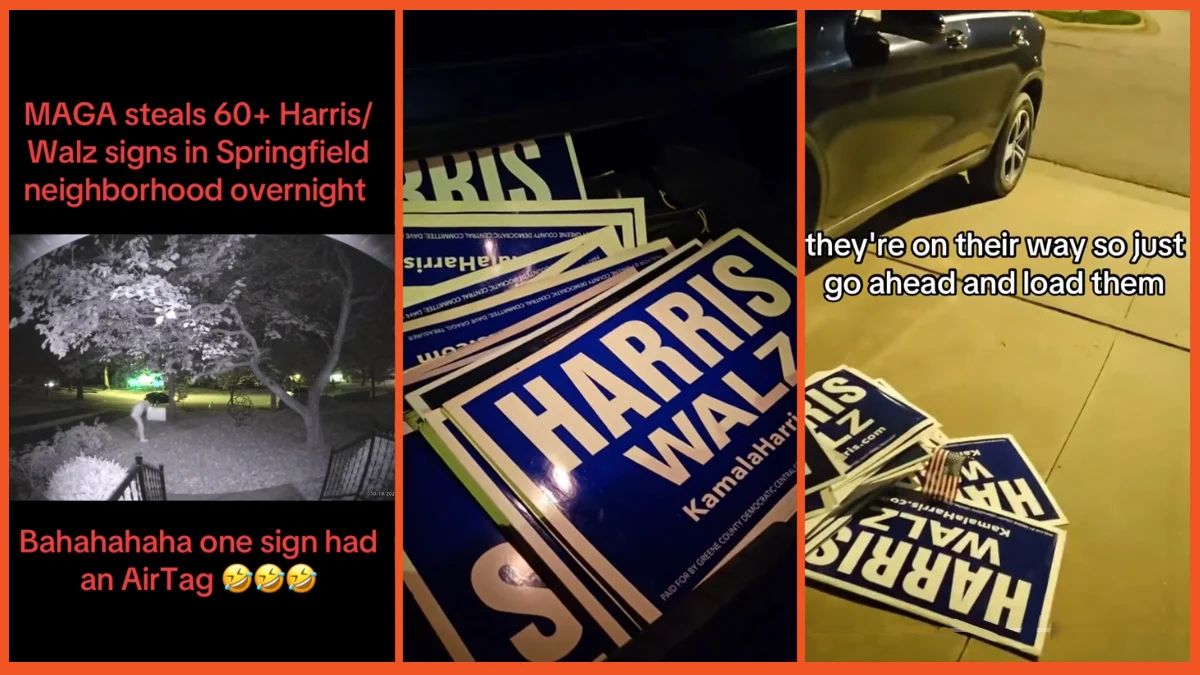
Laura McCaskill, a resident of Springfield, shared the ongoing frustration of her neighborhood via TikTok after experiencing multiple thefts of yard signs supporting Kamala Harris and Tim Walz. Despite capturing the culprit on security cameras, the identity of the thief remained a mystery until McCaskill decided to take matters into her own hands with a creative solution: she placed an Apple Airtag on one of her signs.
After yet another sign was stolen, the Airtag led her and her partner to a restaurant and then on a 30-minute drive to the town of Nixa, Missouri. There, they encountered a homeowner who admitted that her son had taken the signs but dismissed the matter casually, stating, “He’s just an idiot.”
What they discovered next was both surprising and infuriating. McCaskill described finding not just one but 59 stolen signs in the teen’s car. The boy’s nonchalant attitude in light of the evidence was striking, but it was his mother’s reaction that raised eyebrows. In a video clip, she sarcastically tossed the signs to the ground, proclaiming, “Here you go, Liberals,” before belittling the importance of voting.
While the mother brushed off the situation, it’s important to note that stealing election signs is a class four misdemeanor in Missouri, potentially leading to a year in jail and fines up to $2,500. McCaskill pointed out that their community’s stolen signs, if correctly valued, could total around $1,200—far exceeding what the teen had calculated based on an incorrect assumption of their worth.
McCaskill and her neighbors decided to file police reports, feeling that the family’s dismissive attitude warranted accountability. She emphasized the importance of respecting neighbors and their rights, lamenting that a lack of responsibility from parents could lead to a troubling cycle for their children.
This incident serves as a stark reminder of the complexities of youthful rebellion, especially in a politically charged environment. While teenagers often test boundaries, the influence of their surroundings—like a dismissive parent—can significantly shape their understanding of right and wrong. McCaskill’s hope for the boy is that he learns from this experience, recognizing the importance of respecting others’ property and opinions.
As election season ramps up, this story highlights the challenges of maintaining decorum and civility in the face of political passions. It raises questions about accountability and the values that are truly being taught to the next generation, especially in communities where such behavior is brushed aside as youthful mischief.
 Last updated