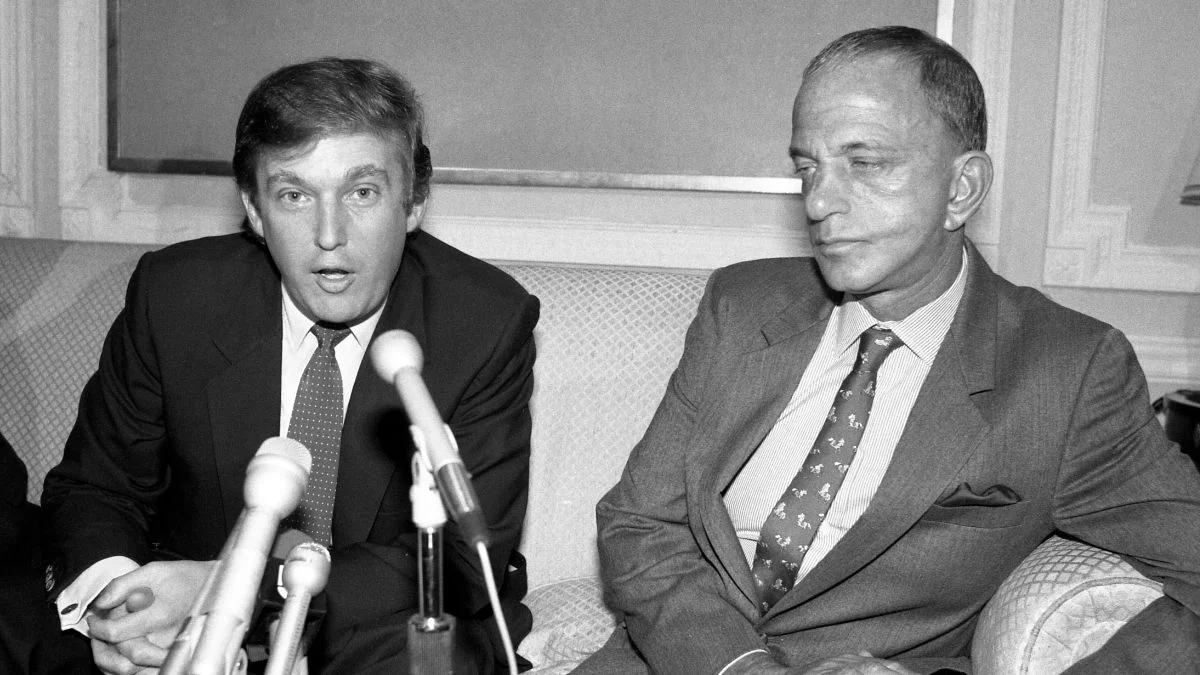
Jeremy Strong’s portrayal of Roy Cohn in The Apprentice has earned significant praise, with critics lauding both his performance and the film’s intense narrative. In The Apprentice, Donald Trump (played by Sebastian Stan) is shown navigating his early career in real estate under Cohn’s guidance. While Trump is well-known today, many younger audiences may be less familiar with the influence of Cohn, a lawyer with a controversial and impactful legacy.
Who Was Roy Cohn?
Roy Cohn (1927-1986) rose to prominence as a lawyer and chief counsel to Senator Joseph McCarthy, playing a pivotal role in the anti-communist investigations of the 1950s. These investigations, now infamous for their baseless and aggressive tactics, targeted numerous government employees and public figures accused of communist ties, in an era that has since been termed McCarthyism. Notably, Cohn also played a significant role in the prosecution of Julius and Ethel Rosenberg in 1953, a case where the couple was convicted and executed for alleged espionage on behalf of the Soviet Union—a conviction that remains controversial to this day.
Cohn’s fervent anti-communist stance extended to his opposition to civil rights and the LGBTQ+ community. He was actively involved in what became known as the “Lavender Scare,” a parallel purge targeting homosexual individuals under the pretense that their sexual orientation made them susceptible to communist influence. Despite the harsh treatment of LGBTQ+ individuals during this time, Cohn himself was widely known to be gay, leading to a deeply conflicted public persona. His private life contrasted sharply with his public crusades, as he became infamous for his ruthlessness and contradictions, even frequenting high-society parties with a “closet of neon lights,” as one observer noted.
Cohn and Trump’s Business Relationship
In 1971, Cohn became Trump’s lawyer and mentor, advising him on a housing discrimination case brought by the Department of Justice. Trump, accused of discriminating against Black tenants, was guided by Cohn, who convinced him to file an ambitious countersuit. Although the countersuit was unsuccessful, Cohn managed to secure a settlement for Trump that did not require an admission of wrongdoing, a legal maneuver that framed Trump’s actions as welfare-related rather than racially motivated. The two developed a close relationship, with Cohn later introducing Trump to political operative Roger Stone, who would be instrumental in Trump’s 2016 campaign.
Despite Cohn’s public persona as a fierce advocate against homosexuality, he contracted AIDS and succumbed to the disease in 1986. To his dying day, he insisted his illness was liver cancer, refusing to acknowledge the AIDS diagnosis due to its association with homosexuality at the time. Shortly before his death, Cohn was disbarred by the New York State Supreme Court for fraudulent practices, achieving what one friend described as his ultimate goal: to die deeply in debt.
Roy Cohn’s Legacy and Media Portrayals
Cohn’s life has been explored in various media, with Al Pacino portraying him in HBO’s Angels in America, a story set during the AIDS epidemic in Reagan’s America, and James Woods taking on the role in the film Citizen Cohn. Strong’s recent portrayal has drawn comparisons to Shakespeare’s Iago from Othello, a character whose cunning and manipulation resonate with Cohn’s real-life influence. Strong described Cohn as a “demonic Peter Pan,” capturing his complex and often dark motivations.
By examining Cohn’s impact on Trump and his legacy, The Apprentice delves into how Cohn’s brand of opportunistic legalism left a lasting mark on American politics.
 Last updated